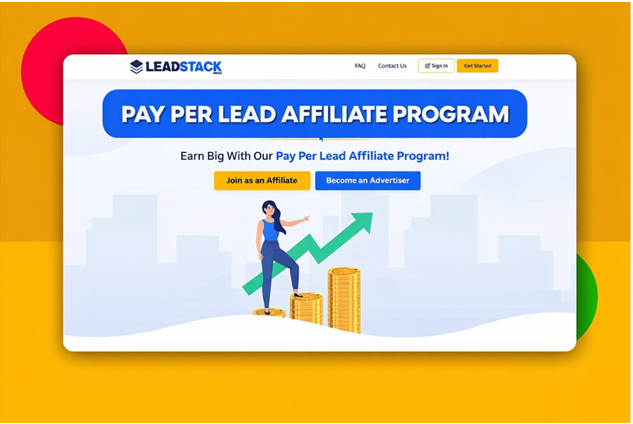
Affiliate marketing has changed a lot over the years. Earlier, most people associated it only with product reviews, discount links, and online shopping commissions. Today, one of the fastest-growing and most practical affiliate models is the pay per lead affiliate program.
This model is especially popular in industries where users do not immediately buy but instead request information, apply, or show interest first. If you are trying to understand how pay per lead really works, why advertisers prefer it, and why affiliates are increasingly choosing it over pay per sale, this guide explains everything in detail.
Throughout this article, the focus will remain on one platform only: Lead Stack Media.
What Is a Pay Per Lead Affiliate Program?
A pay per lead affiliate program is an affiliate marketing model where you earn a fixed payout for every qualified lead you generate, instead of earning a commission from a completed sale.
A “lead” usually means a user who takes a specific action, such as:
• Filling out an online form
• Submitting contact details
• Applying for a service
• Requesting a callback or quote
The important part is this: The user does not need to make a purchase for you to earn money.
As long as the user completes the required action and meets the advertiser’s criteria, you get paid.
This makes pay per lead fundamentally different from traditional affiliate marketing models that depend entirely on sales.
Why the Pay Per Lead Model Exists
Many industries do not operate on instant purchases. In finance, legal services, insurance, education, and professional services, users usually take time before making a final decision.
Advertisers in these industries value qualified interest more than instant payments. They want real prospects they can follow up with later.
Pay per lead solves this problem by:
• Rewarding affiliates for bringing interested users
• Giving advertisers potential customers instead of cold traffic
• Removing the pressure of forcing immediate sales
This is exactly why platforms like Lead Stack Media are structured around lead generation instead of product sales.
How Pay Per Lead Affiliate Programs Work Step by Step
To really understand this model, it helps to look at the complete flow from start to finish.
Step 1: Affiliate Registration and Approval
You begin by signing up with a pay per lead affiliate network. After approval, you get access to:
• Available lead offers
• Tracking links
• Reporting dashboards
• Payout details and rules
With Lead Stack Media, affiliates typically work with lead-based campaigns where quality and compliance matter as much as traffic volume.
Step 2: Selecting a Lead Offer
Each pay per lead offer comes with clear terms, including:
• Target location or country
• Minimum user requirements
• Information required in the form
• Payout per approved lead
• Allowed traffic sources
Some offers pay a small amount per lead but convert easily. Others pay significantly higher amounts but require more qualified users.
Choosing the right offer depends on your traffic source and audience intent.
Step 3: Promoting the Offer
Once you select an offer, you promote it using your preferred traffic method. Common approaches include:
• SEO-focused blog content
• Dedicated landing pages
• Paid advertising campaigns
• Social media traffic
• Email marketing
Your affiliate link ensures that every lead generated through your traffic is tracked correctly.
Step 4: User Submits a Lead
The user clicks your link and lands on a form or application page. They are asked to provide information such as:
• Name
• Email address
• Phone number
• Location
• Basic qualifying details
Because no payment is required, users are more likely to complete the process.
Step 5: Lead Validation and Quality Checks
This step is critical and often misunderstood.
Every submitted lead goes through verification to ensure:
• The details are genuine
• The user meets the offer requirements
• The traffic source complies with the rules
Low-quality or fake submissions are rejected. Clean traffic is approved.
Lead Stack Media places strong emphasis on lead quality, which protects both advertisers and affiliates in the long run.
Step 6: Payout to the Affiliate
Once leads are approved and the holding period ends, the affiliate receives payment based on:
• Approved lead count
• Agreed payout per lead
• Payment schedule
This process gives affiliates predictable and transparent earnings.
How Pay Per Lead Is Different From Pay Per Sale
To appreciate the value of pay per lead, it helps to compare it directly with pay per sale.
Pay per sale affiliate model
• User must complete a purchase
• Longer decision-making process
• Lower conversion rates
• Income depends on final checkout
Pay per lead affiliate model
• User only needs to submit information
• Shorter funnel
• Higher conversion rates
• Faster and more consistent results
For many affiliates, especially those focused on content or SEO, pay per lead removes unnecessary friction.
Why Pay Per Lead Converts Better
There are several practical reasons why pay per lead affiliate programs tend to perform well.
Lower barrier for users
Submitting a form feels safer and easier than entering payment details.
Higher intent traffic
Users filling out applications are usually actively searching for a solution.
Less emotional pressure
You are not convincing users to buy. You are offering information or access.
More predictable revenue
You know exactly how much each lead is worth.
This is why many experienced affiliates build entire businesses around lead generation.
The Role of Traffic Quality in Pay Per Lead
Traffic quality is the backbone of this model.
Advertisers are paying for real people, not numbers. This means:
• No fake signups
• No bots
• No misleading promotions
• No incentivized traffic
Affiliates who focus on long-term growth understand that clean traffic always wins. Platforms like Lead Stack Media actively monitor lead quality to ensure sustainable partnerships.
Trying to game the system usually leads to rejected leads or account issues.
Best Traffic Sources for Pay Per Lead Affiliate Programs
Some traffic sources work especially well with pay per lead offers.
SEO Content
• High trust
• Long-term traffic
• Ideal for informational searches
• Scales steadily over time
Landing Pages
• Focused messaging
• Strong call to action
• Works well with paid campaigns
Paid Advertising
• Fast scaling potential
• Requires strict tracking
• Best for affiliates with testing discipline
Email Marketing
• Works with permission-based lists
• Strong for repeat leads
• Requires compliance awareness
The most successful affiliates usually combine two or more traffic sources instead of relying on only one.
Is Pay Per Lead Suitable for Beginners?
Yes, but with the right mindset.
Pay per lead affiliate programs are often easier for beginners because:
• There is no need to sell products
• Conversion rates are higher
• Funnels are simpler
However, beginners still need to understand:
• Traffic quality rules
• Compliance requirements
• Tracking basics
Starting slowly and focusing on one traffic method is usually the best approach.
Earnings Potential in Pay Per Lead Affiliate Programs
There is no fixed earning limit.
Income depends on:
• Traffic volume
• Lead payout
• Conversion rate
• Consistency
Some affiliates focus on fewer, high-quality leads. Others build systems that generate a large number of leads daily.
What matters most is repeatability, not chasing unrealistic figures.
Why Lead Stack Media Focuses on Pay Per Lead
Lead Stack Media is built around performance-based lead generation. The goal is to:
• Connect advertisers with real prospects
• Reward affiliates for genuine interest
• Maintain transparency and compliance
This approach benefits everyone involved. Affiliates earn reliably, advertisers receive qualified leads, and the ecosystem remains sustainable.
Common Mistakes to Avoid in Pay Per Lead Affiliate Marketing
Many affiliates fail not because the model is weak, but because of avoidable mistakes.
• Chasing volume instead of quality
• Ignoring traffic rules
• Promoting offers without understanding requirements
• Using misleading messaging
• Scaling too fast without testing
Pay per lead rewards patience and precision more than shortcuts.
Final Thoughts
A pay per lead affiliate program is not a trick or a shortcut. It is a structured, performance-based system designed for real businesses.
You are paid for creating interest, not forcing a purchase. That makes the model more stable, more ethical, and often more profitable when done correctly.
For affiliates who prefer logic, data, and long-term growth, pay per lead offers a clear path forward. Platforms like Lead Stack Media exist because this model works when it is approached with professionalism and discipline.
If your goal is consistent affiliate income built on trust and quality, pay per lead is one of the strongest models available today.
(The views, opinions, and claims in this article are solely those of the author’s and do not represent the editorial stance of The Assam Tribune)