
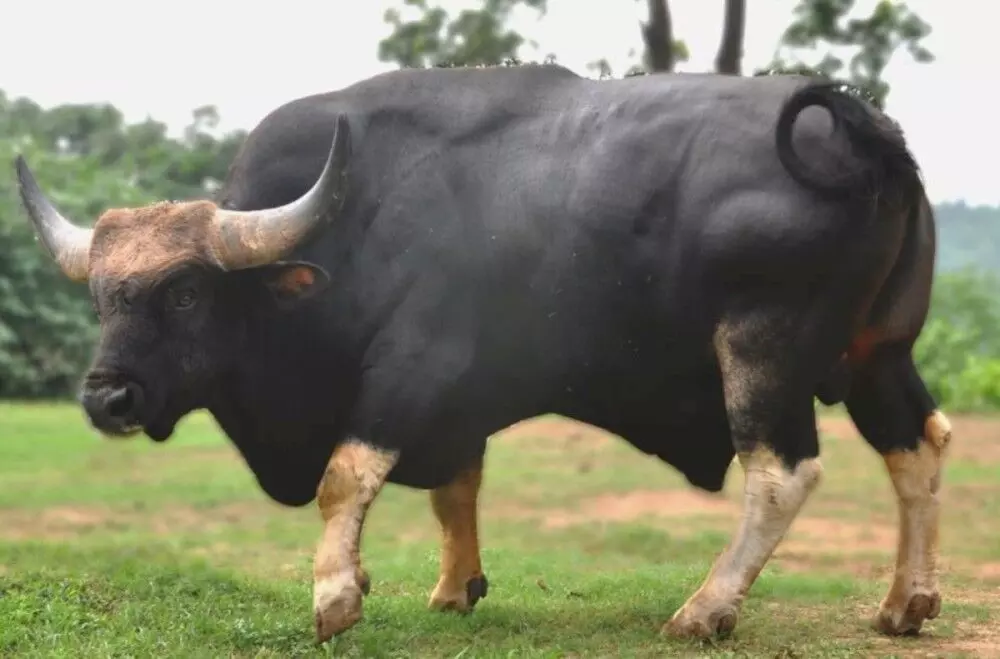
Dimapur, Dec 23: Nagaland’s iconic mithun has entered global livestock history with the registration of Nagami as the world’s first officially recognised mithun breed.
The registration was secured by the ICAR–National Research Centre on Mithun, and formally granted by the ICAR–National Bureau of Animal Genetic Resources, completing the first-ever breed-level documentation of Mithun (Bos frontalis) anywhere in the world.
The proposal for breed registration was submitted under the leadership of the centre’s director, Dr Girish Patil S., while the detailed breed characterisation was led by scientist Dr Harshit Kumar.
The recognition follows years of systematic research aimed at addressing the long-standing absence of formal classification of Mithun populations in the Northeast.
Describing the recognition as a “Christmas gift” to the people of Nagaland, ICAR–NRC on Mithun, said the move would open new avenues for focused conservation programmes, structured scientific breeding and improved livelihood opportunities for Mithun farmers.
Mithun, the state animal of Nagaland, holds deep cultural, social and economic significance for Naga tribal communities.
However, despite its importance, the species had remained outside formal breed documentation, limiting conservation planning, genetic improvement programmes and policy-level interventions.
To bridge this gap, ICAR–NRC Mithun undertook comprehensive phenotypic, morphometric and genetic studies to scientifically establish the identity of Mithun populations native to Nagaland.
The newly registered Nagami Mithun has been identified as a distinct breed based on physical characteristics, ecological adaptation and genetic markers.
Nagami Mithun is characterised by a predominantly black coat with white markings on the lower legs, a compact and sturdy body structure, and strong adaptability to forested hill ecosystems.
Genetic analysis confirmed that it is clearly distinguishable from other Mithun populations found across the Northeast.
The breed is widely reared across several districts of Nagaland under traditional free-range systems, where animals graze in community-managed forests.
Researchers noted that this indigenous rearing practice reflects the breed’s resilience and its close integration with local customs, governance systems and ecological conditions.
According to the institute, the registration is the outcome of sustained engagement with Mithun rearers, village councils and state-level departments, alongside extensive scientific documentation.
The development builds on earlier milestones, including the recognition of Mithun as a food animal by the Food Safety and Standards Authority of India in 2023, and its inclusion the same year in the domestic animal diversity information system of the Food and Agriculture Organisation.