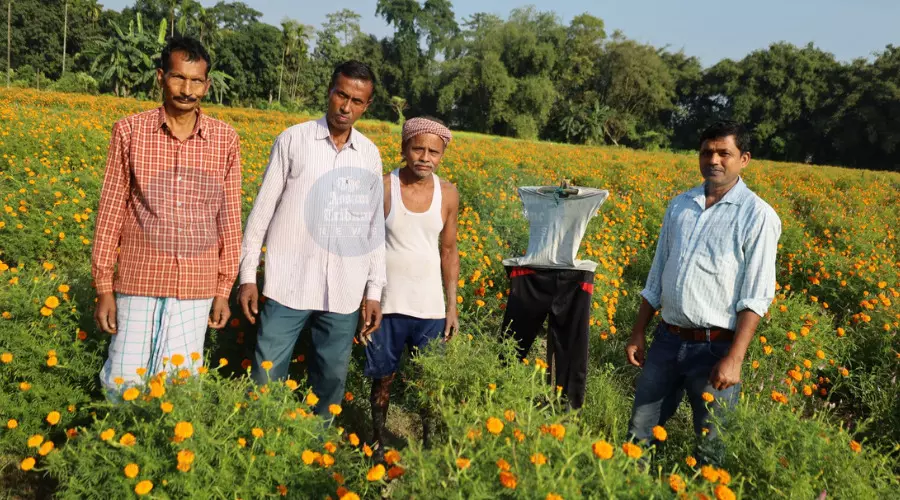
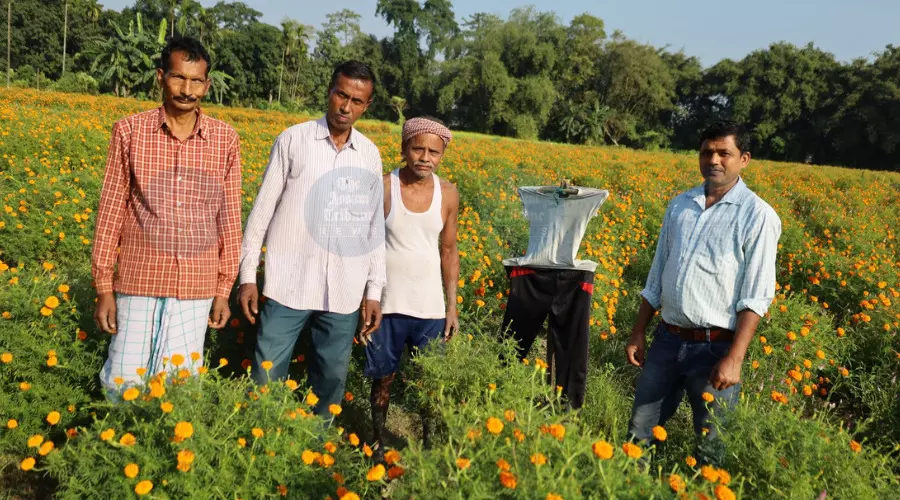
HAJO (Konadia), Dec 12: Despite high demand for household and commercial use, commercial floriculture has not yet flourished in Assam, barring a few pockets such as Hajo, Rangia, Morigaon, Nagaon, Dibrugarh and Jorhat.
Jiten Chandra Das of Kulhati (Konadia), who grows flowers of different varieties on his 8-bigha plot in both summer and winter, said floriculture has huge prospects but a plethora of problems, particularly the lack of a permanent market shed, hits growers hard.
“What matters more to us is a market space in Guwahati to sell our produce in an organised manner, which will bring us optimal return,” Das said, adding that due to the acute scarcity of market space in Guwahati, they have to sell their produce before Guwahati wakes up.
Insisting on the pressing need for market space, a group of growers said, “We offer our flowers for sale in front of households at the early hours in Bharalu. Once residents wake up, we are left with no option but to vacate the space. In this process, we have to sell flowers to middlemen and are deprived of optimal benefit.” They added that they must get up at 3 am to reach Guwahati in time and return to their fields to begin tilling activities.
Rameshawar Das of Pakarkona, who grows flowers on a 5-bigha plot, lamented, “During the rainy season, we suffer loss as we have to sell our produce for a very low price to middlemen in the absence of permanent market space. Since our business is mainly temple- and shrine-centric in Guwahati, a market space between Bharalu and Machkhowa would be a much-awaited relief.”
“So far we have had to shift our selling point four times – from Sukreswar Ghat, Fancy Bazar, Machkhowa and Bharalu,” Rameshawar added. Their long fight for a market space has “come a cropper,” as appeals to the Mayor of Guwahati Municipal Corporation and the District Commissioner of Kamrup have failed to yield results. “We also apprised Chief Minister Himanta Biswa Sarma at Khetri, who assured us of facilitating market space,” he said.
Under the banner of Indramalati Agro Producers Company Limited, farmers wrote to the Commissioner and Secretary to the Government of Assam & APC, Agriculture department, in July 2024 highlighting the problems they face in carrying out their business. They said they lag behind growers in other states because their flowers fade faster. “Our growers need to be trained outside the State to spur growth of floriculture by exploiting the potential to the hilt,” they stated.
It may be noted that then Kamrup Deputy Commissioner Keerthi Jalli, in a letter on July 25, 2024 to the Commissioner of Guwahati Municipal Corporation (GMC), requested a dedicated market space, preferably near Sukreswar Mandir, Panbazar or Fancy Bazar, for Hajo farmers to sell their flowers. Such a space, she noted, would help promote their livelihood.
Hajo is traditionally a flower-growing belt, and more than 1,000 farm families are associated with large-scale production of marigold. They have also begun producing cut flowers such as gladiolus, tuberose, anthurium, chrysanthemum, roses and orchids under the guidance of Indramalati FPC and pioneer growers of the locality.
While the Hajo local variety is cultivated in winter from August to May, the Chirakul apple variety is grown in summer from February to April. Of the two types of Hajo local variety – ahu and sali – the latter grows well in intense winter. Total area under floriculture in Kamrup is 300 hectares, excluding the proposed 123.88 hectares.
Ecstatic about the venture, grower Deepali Das, while plucking flowers, said, “Floriculture brings fame to our village and we are proud of helping our males in supplementing the income.” Growers said they realise profits up to Rs 50,000 per bigha, excluding input costs of Rs 15,000–20,000 per bigha.
A plant produces 150–350 flowers, and one garland that fetches up to Rs 40 requires 20–22 flowers. Prices soar during Vishwakarma Puja and Diwali. Both plucking and wreathing are done mostly by women.
District Agricultural Officer, Kamrup, Manabjyoti Das said Hajo has strong floriculture potential due to high demand in Guwahati, expanding urban ceremonies and favourable climatic conditions. He added that protected cultivation, polyhouses and improved post-harvest handling can significantly boost productivity. With credit access and small cold-chain facilities, Hajo could grow into a major floriculture cluster with year-round production and better profitability.
Girendra Kumar Sarmah, SDAO, Horticulture, said the Agriculture and Horticulture departments in Kamrup provide high-quality seedlings of flowers such as gerbera, tuberose, marigold and orchids to growers, besides supplying sprayers, power tillers, tractors, dryers, polyhouses and technical support. “Usually selling their produce individually at Bharalu wholesale market and Sukreswar Ghat, they earn a profit of nearly Rs 1 crore annually,” Sarmah said.
According to Agriculture department sources, Kamrup plays an important role in flower production and supply to Guwahati, meeting 30 per cent of the State’s total demand, mainly from Hajo and Rangia revenue circles. Total area under floriculture in Assam is less than 1 per cent, compared to 9 per cent in Kolkata. Assam imports flowers worth Rs 8–10 crore annually from neighbouring states.
Sources added that due to lack of cold storage and refrigerated transport, farmers fail to compete with flowers brought in baskets from West Bengal markets in terms of size, colour, freshness and fragrance. Production in Hajo and adjoining areas remains largely unorganised.