Woods are lovely, dark, and deep,
But I have promises to keep,
And miles to go before I sleep,
And miles to go before I sleep
~Robert Frost, Stopping by Wood on a Snowy Evening
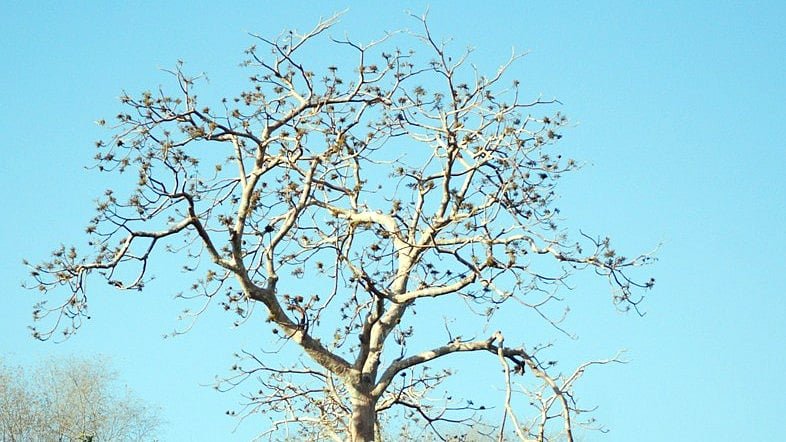
A journey from Bhopal to Sanchi on a crisp full moon night is a treat to a tired soul. The whole landscape on both sides of the road looks gauzy. Amid the forests, stand Ghost Trees, or Sterculia Urens, or Kulu. Ayurveda calls this tree ‘Bhootya’.
After the moon climbs up the heaven and gazes at the Ghost Trees, their silvery branches glisten under the glow of the moon. Because they look like spectres, they are called Ghost Trees of MP.
They are an enigma and have been hiding their secrets from humans for over 27 million years. A 27-million-year-old fossil leaf of a related species, Sterculia labrusca, indicates its age.
Anyway, such a picturesque sight in the calm night fascinates the brave to unveil the mystery of Ghost Tree dotted with patches of broad floating leaves, reflecting the mingled rays of the rising Queen of the Night surrounded by stars.
This is a sketch of one side of the forest. The other side stretched a dark belt of trees, over which in the background towered the range of craggy hillocks.
Afar, an amorous nightbird twitters to wake up its loved one. The deciduous tree comes under the Malvaceous, or mallow, family.
The Marathi name of this tree is Bhootiya, signifying ghostly, but there is nothing to be afraid of. It sheds its leaves during the dry season. The purpose is to survive drought. Its leaves are light green.
It appears haunted on a moonlit night because of its pale, whitish bark. The leaves sport a lavender colour before their fall.
When the tree is in full bloom with greenish-yellow flowers, it delights. A closer inspection of the Ghost Tree reveals its life. The tree is blessed with one papery layer after another. The tree sheds its bark containing translucent parchment in tinges varying from pale peach to bright copper.
The tree is a vivacious canvas. Its bark changes hues and texture as it ages. In the spring, the thick flakes of its bark chip off in varied shapes and leave shallow dents that appear in different shades that look vibrant under the bright sunlight and pale moonlight.
But most of the year, the tree remains leafless. During the monsoon, its branches become green with large leaves. This tree has commercial uses, too. Its roasted seeds and gums are used to prepare traditional foods and oil.
Its nuts are roasted and eaten. The tree is also a source of gum, or karaya, which industries use to thicken, bind, emulsify, and stabilise foods, beverages, ice cream, sherbets, and salad dressing.
Its gum is rinsed in water to form a gel, which is consumed to treat constipation, but it is yet to be scientifically proven. The cosmetic, pharmaceutical, and dental industries use the gum of this tree.
The powder made from its seeds is used in lozenges for treating sore throats, mouth blisters, wounds, bedsores, and respiratory problems. Its gum is also used to treat wounds and make soaps.
The gum naturally comes out of its branches when the bark is damaged, but the gashes made to extract its gum harm the tree. Now, a scientific method is applied to do it.
A visitor can find this tree in different parts across the state. It is especially sighted on the way from Bhopal to Sanchi, in Pench National Park, Kanha Tiger Reserve, and Patalpani-Kalakund Ghat.
Ghost Tree is different from Arjun, though both look alike briefly. Arun grows in moistened land, and Ghost Tree prefers rocky dry land. The Bhopal-Sanchi road meanders through the forests with highlands shining under the moonlight. But our ride continues.